How Lisa Oakley’s "A Spectrum of Behavior" Helped Me Name Difficult Faith Experiences Without Abandoning Belief

Updated: Sep 10
A faith-affirming framework for understanding behavior in faith-based relationships that acknowledges difficulties while holding onto faith and belief.

I write from lived experience, more than twenty years of serving as a church youth leader, and ongoing learning about evidence-based safeguarding that names harm without undermining faith.
Why Identifying Behavior in Faith-Based Relationships Can Feel So Polarizing
Several years ago, I was at the end of my rope with words.
At first, certain words felt validating. Terms like church hurt, religious trauma, and spiritual abuse summed up some of what I'd experienced as a teen during a difficult faith change.
But then I saw how those terms were often being used. Blacklisting entire faith communities or labeling them as "toxic" didn't reflect the good I'd experienced in the same communities where I'd encountered (fewer instances) of harm.
So I set those words aside, and I kept searching. Wasn't it possible to acknowledge harm without abandoning belief? Did it have to be this hard? Then, in my personal study a pattern emerged in the New Testament.
My First Answer—Jesus Christ
Looking at Jesus' interactions in His faith community, I noticed a few things:
He didn't shy away from addressing harm.
He frequently called out problematic behavior.
He did so in ways that not only didn't abandon faith and belief, it increased it.
It was also clear that everyone kept their place at the table. No one was beyond redemption, growth, or healing.
Eventually, I stumbled on the faith-affirming framework I was looking for. But first, let me back up and reference a new study on behavior in faith communities that I think is important.
If Most Behavior in Faith Communities is Healthy, Why Name What Is Not?
In April of 2026, the Wheatley Institute published The Religion and Mental Health Connection. After reviewing over 1000 high-quality studies catalogued in the Oxford University Press Handbook of Religion and Health, their finding was that positive associations between improved mental health and involvement in a religious community outnumbered negative associations nearly 10 to 1. This affirms what I (and many others) know from lived experience: in most cases, individuals and society are strengthened by religious communities (though sometimes, they are not).
Because of my own personal experiences, when I hear "ten to one," by heart automatically goes to the "one in ten" whose experience has been difficult. I know that for most, one in ten doesn't sound like a lot. But think about what that means in real numbers. Take a congregation of four hundred. One in ten is forty people. Or a religious university of several thousand, now that's a few hundred.
Suddenly, "The One" adds up.
And The One doesn't stay frozen in time. The One grows up. The One raises a family. Sometimes they stay in their faith and keep ties with friends and family, other times, they do not. In some cases, the One repeats patterns they think are normal. Other times, they overcorrect in an attempt to avoid repeating the past.
As one who spent decades navigating all of that, I can tell you how complicated it is. Which is why the faith-affirming framework I stumbled upon has been so meaningful and impactful for me and three generations of my family, each with their own experiences as The One.
Professor Lisa Oakley's A Spectrum of Behavior
As a woman of faith, and a qualitative researcher, Professor Lisa Oakley chaired England’s National Working Group on Child Abuse Linked to Faith and Belief. After studying behavior in faith communities for many years, that work led to the development of a practical evidence-based tool: A Spectrum of Behavior.
Professor Oakley's spectrum has made it possible for many like me to name difficult experiences without throwing out all that is good. In fact, it validates and confirms what is good so we know what that looks like, and we can contribute to more of the same.
A Brief Note on the Term “Spiritual Abuse”
Before sharing Professor Oakley’s categories, I want to point out the difference between her use of the term spiritual abuse and how I've often seen it broadly used in ways that feel weaponized. Rather than labeling entire belief systems, Professor Oakley’s work focuses on identifying specific patterns of behavior.
Another thing worth mentioning is that fact that if, like me, you’ve wrestled with the term spiritual abuse, this framework may be helpful whether or not you choose to use that term.
The Four Categories of Behavior in Oakley’s Spectrum
Professor Oakley identifies four categories of behavior in relationships tied to faith and belief. The definitions below are Lisa Oakley’s, quoted verbatim:
Healthy Behavior
Good, nurturing behavior where people flourish and grow.
Unhelpful Behavior
Reactions/behavior that is not harmful but not helpful. We all behave this way at times.
Unhealthy Behavior
If/when we see a consistent pattern of behavior that is negative, where we check ourselves before approaching that person and where they are not open to questions. Much of behavior that concerns us sits here. It can still be addressed at this stage.
Spiritual Abuse
If it becomes a persistent pattern of coercive controlling behavior that reflects the definition of psychological abuse.
Professor Oakley's spectrum reflects a complete picture: behavior in faith communities can be nurturing and good, while still needing language for behavior that is harmful (or simply unhelpful).
The Iceberg Model
When I first came across Professor Oakley’s spectrum, I began to picture people (and their experiences) as icebergs. The following is my adaptation of her work.
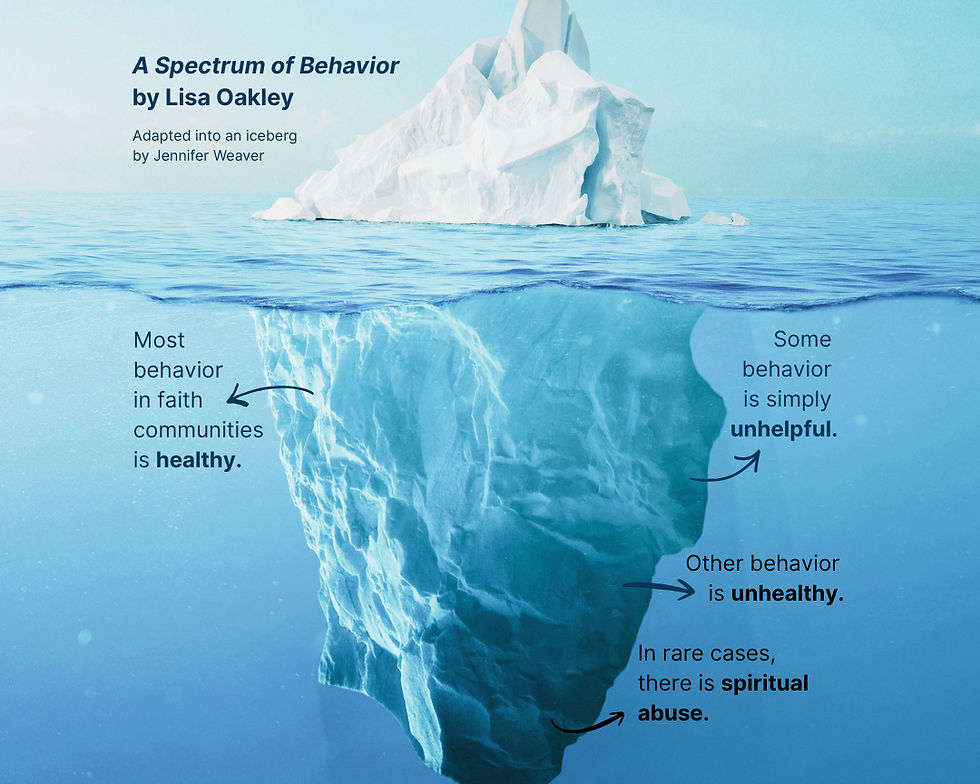
Looking at an iceberg, we only see what's above the waterline or what's visible in the moment: someone who looks happy or stressed, or a comment, reaction, disagreement, or interaction that is healthy, unhelpful or unhealthy.
But beneath the surface lies more: our accumulated experiences with behavior in faith-based settings and relationships. In my adaptation of her work, the entire underwater portion of an individual’s iceberg is made up of the same four categories identified in her research:
Healthy Behavior
Unhelpful Behavior
Unhealthy Behavior
Spiritual Abuse
Since each of our icebergs is shaped by a different past, many people’s underwater (or past experiences) are unique. Some icebergs may be made up of mostly healthy interactions (with a few blips of unhelpful or unhealthy behavior). Others carry deeper layers of unhealthy patterns, or, in rarer cases, abuse.
Why This Matters in Real Relationships
Usually, we don't see what’s below the surface when we interact with people, but sometimes we do. For example, when a trigger appears or if someone shares an experience with us. This may explain why two people can walk away from the same interaction with very different interpretations of what just happened. It also explains why it’s unhelpful to simply dismiss those interpretations as misperception or oversensitivity.
All Imperfect Behavior Is Not Spiritual Abuse
To be clear, not everything that goes wrong in a faith-based setting or relationship is spiritual abuse. Being clear and careful in how we name behavior can prevent knee-jerk reactions, escalation, false accusations, and minimizing harm. It can also help us respond well and minister more like our Savior would. And, address problematic behavior more effectively.
Why This Framework Is So Helpful
Professor Oakley’s spectrum gives us good questions to ask, rather than responding with knee-jerk reactions.
Questions:
Is this behavior a one-off incident that was simply unhelpful?
Is it part of an ongoing pattern that fits the unhealthy category, but can still be addressed?
Is this behavior consistent with psychological abuse that must be stopped immediately?
In some faith communities, like mine, a significant number of interactions happen among members in everyday life (outside of formal church settings). For example, between parents and children, siblings, spouses, friends, work colleagues of the same faith, missionaries, and roommates at religious universities. In my experience, this is where this framework has been especially helpful as this is where behaviors like bullying, harassment, hazing, harsh discipline, coercion, or gossip intended to harm an individual's reputation may show up. Naming these behaviors clearly and placing them along a spectrum can help us know when to speak up, give grace, or seek additional help.
Still Unsure of the Term Spiritual Abuse?
If you're still uneasy with the term spiritual abuse, you are not alone. After seeing the term used inconsistently (and too broadly), I understand the discomfort.
In my own faith community, I've only found one example where this term is used in church materials despite extensive abuse prevention resources.
The good news is that even if we set aside the term spiritual abuse, there are still ways to identify (and prevent) harmful behavior.
Another Option: Name The Specific Behavior
Rather than relying on a single term like spiritual abuse, my faith community focuses on naming specific behaviors. Alongside definitions of more widely recognized forms of abuse, this section includes “Other Abusive Behaviors,” with the clarification that “while not all of these would be defined as abuse, they are all harmful behaviors against the teachings of the gospel.”
Some examples from my faith community's website
Emotional and verbal abuse: words or actions that undermine emotional development or self-worth. Examples: constant faultfinding, belittling, rejection, and withholding of love, support, or guidance.
Harsh Discipline: criticism or ridicule that undermines confidence, rather than guiding a child to learn right from wrong.
Harassment: creating a hostile environment through comments, gestures, innuendo, or violations of personal space.
Bullying: aggressive behavior with the intent of causing injury or discomfort. Examples: physical contact, words, or more subtle actions.
Hazing: Hazing can occur when a peer imposes an inappropriate or humiliating task on another peer as part of an initiation into a group.
Seeing these behaviors clearly defined clears up confusion. Even without using the term spiritual abuse, you can see how these definitions clearly name behaviors that cause harm.
A Definition That Ties it All together: Coercion
Alongside the examples above, one definition from my church's youth protection training stands out:
“Coercion can occur when a leader (and I would add, parent) compels a child using religious language or authority that implies a spiritual obligation or duty, permission, sanction, punishment, justification, intimidation, or threat. This is contrary to the Savior’s teaching that individuals should lead ‘only by persuasion, by long-suffering, by gentleness and meekness, and by love unfeigned.’” —Youth Protection Training
When I share this definition, it often catches people off-guard, which makes sense, because religious language has, at times, been used in ways that imply obligation or duty. The key word here is compels.
Compulsion is the opposite of what Jesus modeled.
Christ invited, taught, and inspired those He came in contact with while leaving room for agency. His interactions highlight the fact that becoming “a new creature” (2 Corinthians 5:17) is an ongoing process or a "line upon line," "precept upon precept" journey (Isaiah 28:10). Conversion rarely happens all at once, and it cannot be coerced.
The point is, authority, correction, and instruction isn't the problem. It's how we lead and instruct while trying to influence faith. Many handbooks and trainings in various faith communities outline Christlike influence. See my collection of resources for various faith communities.
If Not Coercion, Then What?
Throughout the scriptures, Jesus modeled leading, teaching, and ministering in ways that preserved dignity and agency while inviting real change. A few examples that come to mind:
Lead Like a Good Shepherd
When lost sheep see their shepherd coming, they don't feel embarrassed or ashamed, they feel relief.
See Conversion as a Path
A path implies one (or a few) steps at a time, giving room for mistakes, learning, and growth.
The Way Is “Strait”
A "strait" is a body of water full of mud, rocks, and currents. This is much different than a "straight" path that unfolds perfectly without course-correction.
Meet People Where They Are
When has someone met you where you were (instead of rushing you beyond your capacity?) What happened next? Did it empower growth?
Trust Christ
As far as helping others, Christ needs us, but sometimes, not as much as we think. When others aren't where we think they should be, we can look at His timelines in our own lives, then trust that they are just as perfect with someone else.
For ideas on responding well to a loved one's difficulty, see: How to Respond When Someone Shares a Painful Experience in a Faith Setting or Relationship.
For a personal example of navigating the aftermath of difficulty in faith-based relationships, see: How I Reclaimed My Agency And Navigated Difficult Experiences in Faith Settings.
Frequently Asked Questions
What is the Spectrum of Behavior in faith-based relationships?
A Spectrum of Behavior is a framework developed by Professor Lisa Oakley from her fourteen-year study of behavior in faith communities. It organizes behavior into four categories: healthy (where people flourish and grow), unhelpful (not harmful but not helpful), unhealthy (a consistent negative pattern that can still be addressed), and, in rarer cases, a persistent pattern of coercive control that aligns with psychological abuse.
Research consistently shows that most behavior in faith communities is healthy—which is why it can be difficult to recognize or name behavior when it falls outside of that.
What is the iceberg model and why does it matter in faith settings?
The iceberg model, developed by Jennifer Weaver as an adaptation of Professor Lisa Oakley’s work, A Spectrum of Behavior, pictures each person’s accumulated experiences in faith-based relationships as an iceberg. What is visible above the surface is the current interaction. Beneath it lies a person’s full history of experiences—healthy, unhelpful, unhealthy, or harmful.
Two people can walk away from the same interaction with very different reactions, not because one is wrong, but because their “icebergs” are different. Jesus saw beneath the surface—He ministered to where people actually were, not just what appeared on the surface. He can help us do the same.
What is coercion in a faith setting according to youth protection training?
Youth protection training in at least one faith community defines coercion as compelling someone using religious language or authority in a way that implies spiritual obligation, duty, permission, sanction, punishment, justification, intimidation, or threat.
This is contrary to the Savior’s teaching that individuals should be led “only by persuasion, by long-suffering, by gentleness and meekness, and by love unfeigned.” The key distinction is the word compels. Jesus invited, taught, and inspired—He never compelled.
Coercion can also take more than one form. It may include pressure toward belief, pressure away from belief, or consequences tied to deeply held convictions.
Why does it help to carefully name behavior in faith-based relationships?
Careful naming prevents two problems at once: minimizing real harm and over-labeling ordinary human imperfection. When we can distinguish between an unhelpful comment, an unhealthy pattern, and something more serious, we are better equipped to respond wisely.
This may mean extending grace, addressing behavior directly, or seeking additional support. Careful naming brings clarity, and clarity helps us respond more like the Savior—with intention rather than reactivity.
Naming behavior in faith-based relationships is not an attack on faith. When done well, it actually protects it.


Comments